
When people hear the words cinematic travel videos, they usually imagine expensive cameras, drone shots, crazy transitions, and perfectly empty streets at sunrise.
But honestly, that’s never been what makes a video feel cinematic to me.
For me, cinematic travel videos are not about showing a city. They’re about showing how life feels inside that city. That feeling is the most important part.
When I travel, I don’t rush to shoot immediately. I like to observe first. I like to walk slowly, look around, and pay attention to people, movement, light, sounds, and energy. I try to understand what makes that place feel different from every other city I’ve visited before.
I find myself wondering:
- What would it feel like to live here?
- Would I enjoy this lifestyle?
- Why do locals move differently here?
- What do tourists notice that locals no longer see?
- And somewhere between those thoughts, I start filming.
I Observe Before I Take a Video or Photo
I think observation is one of the biggest reasons my travel videos feel cinematic.
I’m not only filming buildings or landmarks. I’m filming atmosphere. I’m filming people existing naturally inside those places.
Sometimes it’s a couple laughing while crossing the street.
Sometimes it’s sunlight hitting a bakery window.
Sometimes it’s a shadow reflecting across a restaurant wall.
Sometimes it’s tourists stopping to admire something locals pass every day without noticing.
Those little moments matter to me more than perfect shots.
One of my favorite memories was in London near Tower Bridge during sunset by the River Thames. We noticed the most beautiful reflection of the bridge on a restaurant window while people inside casually continued eating dinner like it was completely normal.
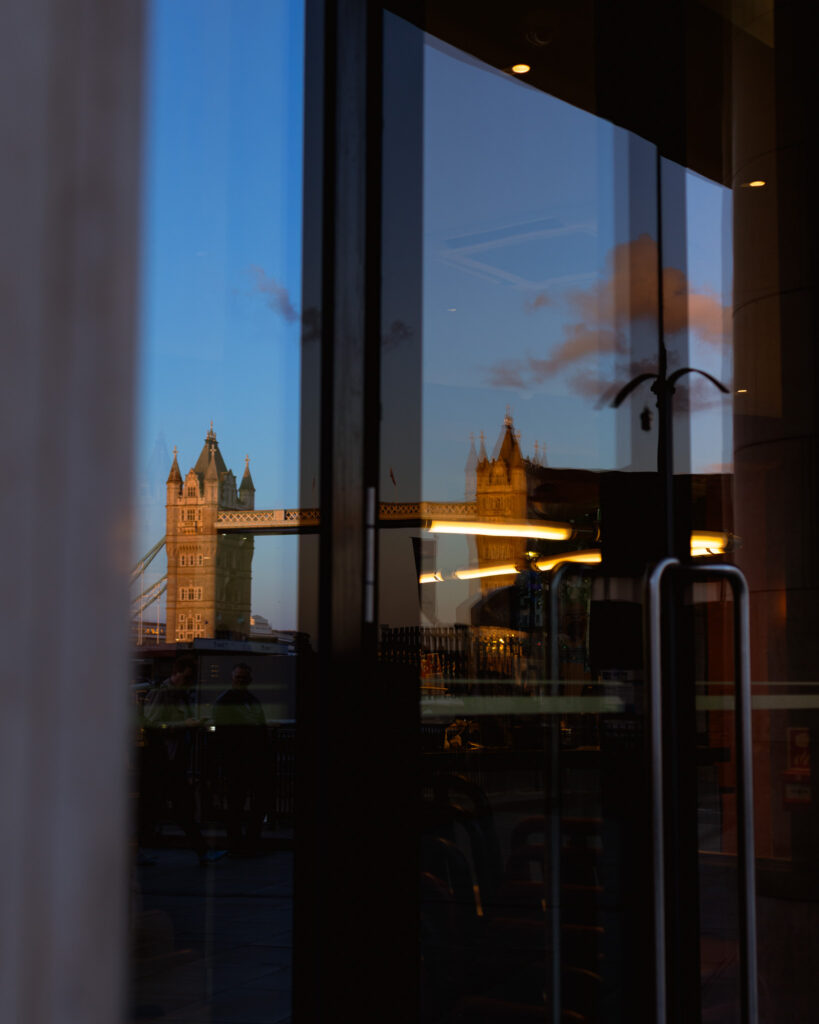
And that moment stayed with me.
Because to me, that’s art.
Not staged art.
The art of living.
The idea that someone experiences this beauty every single day without even thinking about it anymore.
That feeling is what I try to capture in my videos.
Wide Shots Show the Place. Close-Ups Show the Emotion.
I love wide shots. They help establish the city, the architecture, the atmosphere, and the scale of a place.
But if a video only has wide shots, sometimes it can feel emotionally distant.
Wide shots show where you are. Close-ups show how it feels to be there.
That’s why I naturally gravitate toward details:
- reflections
- hands
- coffee cups
- movement
- shadows
- people walking
- birds flying across the frame
- train windows
- light hitting faces
- little interactions between strangers
These are the moments that create emotional connection.
In cities like Amsterdam, I became obsessed with filming people sitting near the canals, eating dinner, talking quietly, riding boats, or simply existing inside such a beautiful atmosphere.

There’s something deeply cinematic about everyday life when you slow down enough to notice it.
I Don’t Want to Fake the Emotion of a Place
When I edit my videos, I usually prefer warmer tones while still keeping the colors natural.
I don’t enjoy heavy editing that completely changes the reality of a place.
My goal is not to create fake emotion.
My goal is to preserve the emotion that already existed there.
That’s why I usually focus on:
- soft contrast
- natural skin tones
- warm light
- realistic shadows
- gentle color grading
I want people to feel the atmosphere honestly.
Because sometimes the original feeling is already beautiful enough.

Music Is One of the Most Important Parts of Video Editing
Music completely changes how we experience visuals.
Not only in films or photography, but in everyday life too.
Think about entering:
- a café
- a spa
- a store
- a bar
- a hotel
Music changes the emotional experience immediately.
It creates memory, mood, comfort, nostalgia, tension, softness, or energy.
That’s why music is one of the most important parts of my editing process.
Sometimes I even build the entire pacing of a travel video around a single feeling a song gives me.
The clips start breathing differently depending on the music.
And honestly, I think that’s one of the biggest reasons cinematic videos feel emotional. They don’t only show visuals. They create atmosphere.
Why I Shoot Handheld
I know many filmmakers prefer extremely stable setups, but I personally love shooting handheld.
That’s actually one of the biggest reasons I chose the Canon EOS R7.
For me, stabilization and close-up flexibility were more important than chasing the “perfect” camera setup.
Handheld shooting feels human.
It feels alive.
And because I focus so much on people, movement, and real-life moments, handheld filming helps me stay connected to the environment around me instead of feeling separated from it.
Of course, I still love stable footage. But I also think tiny natural movement can make a scene feel more immersive and real.
The Most Cinematic Moments Usually Happen Naturally
Some of my favorite footage I’ve ever captured came from places like Paris and Amsterdam.
Not because I planned every frame perfectly, but because I allowed myself to experience those places emotionally first.
- The boats.
- The slow movement.
- The reflections.
- The people.
- The birds crossing the frame.
- The layering of close-up and wide shots together.
Sometimes the final story only fully comes to me after the trip is already over.
After I’ve lived it.
After I’ve felt it.
And maybe that’s why I love travel videography so much.
Not because I’m trying to prove I visited somewhere.
But because I want to remember how it felt to be there.
The Camera Is Just a Tool, I Use it to Share My Vision
Mariam Megrdichian
📍 Location: Los Angeles, California, USA
📷 Photography, visual storytelling, cinematic life
Discover more from Mar's Thoughts Abroad
Subscribe to get the latest posts sent to your email.